

supermoon
dispatch 77

I’m writing this on the first morning that I have woken up, felt called to write, and actually have. The first time in 19 months where I didn’t just wake up for the gym or to get in a few extra hours of work, but instead crawled down to the couch and opened my computer to see if I could still do this thing that I used to love. A little bit of winter quiet space where I’m not filling time with the next thing to. be done. Through the window the blue-grey glow of early morning snowfall, of a world gone soft and cold.
I just finished Rebecca Boyle’s very good Our Moon: How Earth’s Celestial Companion Transformed the Planet, Guided Evolution, and Made Us Who We Are and its sending me down middle-of-the-night rabbit holes left and right. I spent my pre-teen years astronomy-obsessed from the moment I saw my first star chart. And while most of it has fallen away, like a language I was too careless to practice, there are glimmers of remembrance. I still hold up my finger to trace Orion’s belt to the Pleiades and it makes me smile every time. I still remember the most important part, the looking up.
supermoon
Regardless of where you are in the world, your night sky today will be lit by a Full Moon in Gemini, a supermoon which occurs when the Moon’s full phase coincides with the point in its elliptical orbit where it is closest to Earth. During these events, the Moon doesn’t just appear bigger and brighter, but stronger too. High tide is higher. We may not feel the Moon’s pull but it’s there all the same, gently cupping our chin and pointing our eyes towards the sky.
Credit for our knowledge of the elliptical orbit of the Moon, the very thing that gives us tonight’s supermoon, goes to German mathematician, scientist, writer, and unexpected defense attorney Johannes Kepler. Building on the work of others, Kepler used experimentation and observation to develop the laws of planetary motion and to to posit that the Earth and planets revolve around the Sun.
As commonplace as this sounds, Kepler’s findings were a bit of a * hot take * when other thinkers had bent over backwards to try to explain the motions of the planets in a way that put Earth at the center of things. In the early 17th century, a time heavily controlled by organized religion, the idea that God’s crown jewel of a planet wasn’t at the center of the universe was a dangerous one to posit, even if it was true.
Controlling the optics of space is a form of power that is still leveraged today, as tech billionaires (and heavy sigh, trillionaires) compete to pull our Moon into their ruinous web of extraction and dominance. In the 1600s, as today, control is always a form of violence.
The Moon is often associated with witchcraft in myth, and this plays an unexpected role in Kepler’s own story. The witch-craze of the 16th and 17th centuries, which would kill an estimated 50,000 people, mostly women and the elderly, has been studied as an attack on ancestral knowledge, a tactic in support of the privatization of property, and general hatred of women among other things.
In the 1600s, Katharina Kepler, Johanne’s mother, was formally charged with witchcraft* and imprisoned. She was a herbalist and healer who had a special relationship with celestial bodies, using ancestral methods of communication that informed her healing practices. She was also a widowed property-holder who was financially independent, a rarity for the time.
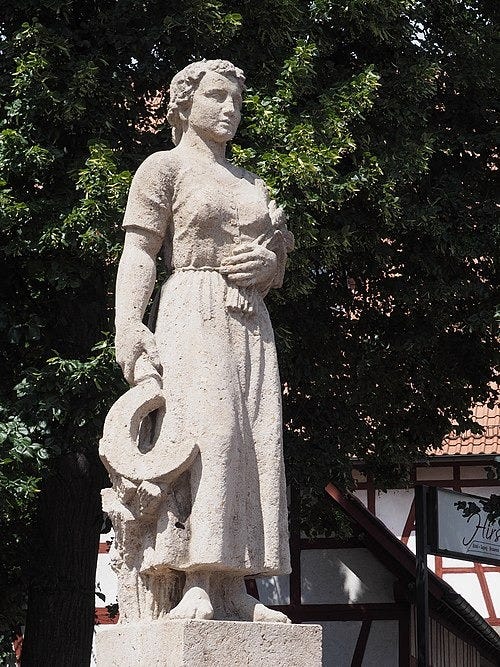
During her trial, Johannes came to his mother’s aid, using the same logic and diligence he brought to his astronomical study to her defense. Six years of her own perseverance, aided by the ceaseless work by her son saw her release, though she would die within the year. For the last year of her imprisonment, she was chained to a wall and repeatedly threatened with bodily torture. The psychological torture she endured in these conditions is incomprehensible.
From these centuries later I mourn the loss of her life and her knowledge. We lose so much of ourselves as a species when we inflict brutality on other beings.
Kepler’s work changed the course of astronomical study and shaped the ways we see the universe today. And Kepler’s worldview was shaped by his beloved mother, her attunement with nature and her healing capabilities. In a work published after his death, Somnium, often credited as the very first work of science fiction, Kepler dreams of a young man and his witch mother, who call forth a spirit who tells them of the moon and those who live there.
Somnium is a beautiful piece of writing, hopeful and human. It weaves the threads of a magical worldview and a scientific one tightly, troubling artificial boundaries and reminding us where we come from. It imagines a world where the sky is vast but we are not alone.
As the Cold Moon rises tonight, I’ll think of Katharina Kepler. Of the role that she and her son played in the way we see ourselves against this backdrop of sky. Of the ways that her cultivated and intentional relationship with the natural world helped her son to look up and wonder so that we could look up and know.
Things I read/watched/listened to lately:
Florence + the Machine’s Everybody Scream: The whole album is stunning. It feels raw and healing. If Dance Fever was a recovery album, this is the reckoning on the other side with all of the parts you have ever avoided. Every song is a favorite but if I truly had to pick just a few they’d be Sympathy Magic, Perfume and Milk, and Witch Dance. Still thinking about this sequence:
Ran to the ancestral plane, but they all showed up drunk and insane
When I asked what I could offer them
They said, “Gin and tonic or lithium?”
I asked, “Which way should I go?”
Through cigarette-smoke they said
“Child, how would we know?Our Moon: How Earth’s Celestial Companion Transformed the Planet, Guided Evolution, and Made Us Who We Are by Rebecca Boyle: Referenced above, this book bridges theories of the formation of Earth and the Moon, how celestial mechanics shaped our understanding of time, and the role of the moon in the evolutionary story of life on Earth. My favorite parts covered the study of ancient technologies for tracking time. Ancient humans are often portrayed as primitive and a bit simple, but the sophisticated ways they used the moon to ensure their needs were met blows my mind.
Ancestors by adrienne maree brown: The third and final book in the Grievers trilogy follows Dune through change, grief, and coming to terms with her own gifts amidst a new constellation of relationships and community. adrienne’s work always makes me hopeful that we, as humans, can build something beautiful in the what-comes-next.
Pluribus: In a very different kind of apocalypse story, miserable-as-a-personality lesbian, Carol, finds she’s one of 13 people on Earth immune to a virus that causes all humans to become part of a hive mind. A take on AI’s flattening of human expression, tech dude’s obsession with singularity, grief, and consent this show is horrifying and hilarious.
That’s all for today, friends. I hope you’re hanging in there and finding the glimmers amidst it all.
Till next time.
Lisa
*While her behaviors may seem witchy by today’s standards, to our knowledge Katharina did not identify as a witch or practicer of witchcraft. While folks using the term now is fine and good, I think it’s important to note that a majority of those charged with and killed for witchcraft were ordinary people with ancestral skills, property, and/or deeply shitty neighbors.